
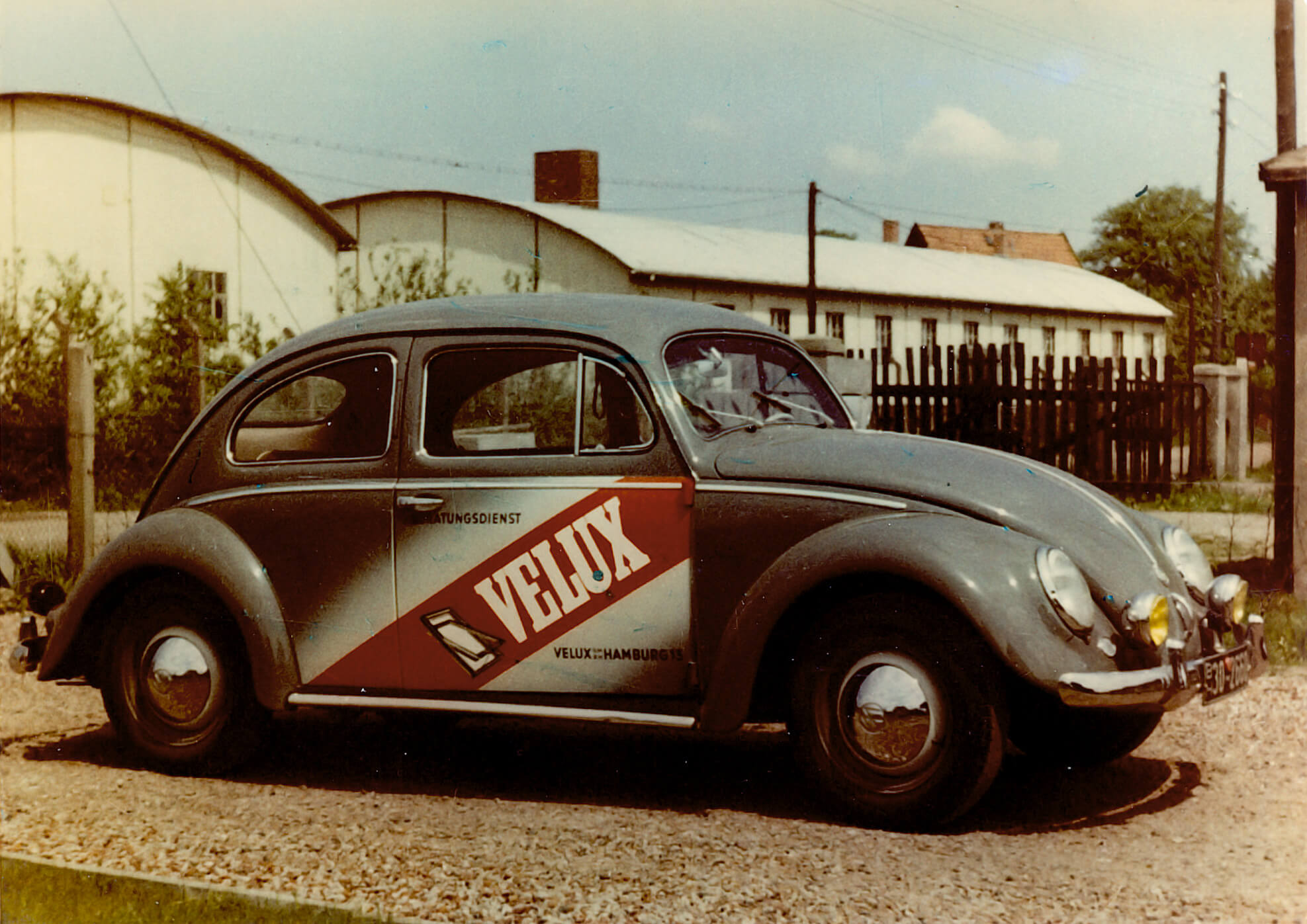
Timeline for the VELUX Group
Villum Kann Rasmussen (1909-1993)
The founder of the VELUX Group, Villum Kann Rasmussen was born in 1909 on the small Danish island of Mandø, not far from the Danish-German border. He graduated in structural engineering in 1932 from the Technical University of Denmark, in Copenhagen and, in 1941 he founded the company V. Kann Rasmussen & Co specializing in glass roofing.
Villum Kann Rasmussen was an innovative experimental scientist and product developer with the motto “One experiment is better than a thousand expert views”.
The VELUX roof window
In autumn 1941, KR was invited to tender for the roof windows required for two Danish schools. The new window construction was based on wood on the inside and zinc on the outside. The window was also designed to draw off condensation and the glass was mounted in the frame without the use of putty. This made the roof window watertight and largely maintenance-free. The window was made in standard sizes to match the usual distance between rafters in Danish roofs.
The new window was named VELUX, derived from VE for ventilation and LUX for light. VELUX was registered as a trademark in Denmark on 3 October 1942.
In 1945, Villum Kann Rasmussen filed for a patent for a “fully” VELUX reversible window with a pivot hinge. The new pivot hinge made it possible to rotate the window sash on its own axis. This meant that it was now easier to clean the outside of the window pane from indoors. The reversible VELUX window (FV) was launched in 1946.
A Global Group and VELUX France
The first foreign company was established in 1952, when KR formed a partnership with Ernst G. Albers, the owner of the joinery E. Albers & v. Drathen (ALDRA) in Meldorf in Germany. Together they established an agreement so that the windows for the German market would be manufactured in Meldorf while hardware and know-how would be supplied from Denmark
In 1964, VELUX France, was established in rented offices in Bagneux south of Paris. In 1969, VELUX France moved to its own new premises in a building in Morangis near Orly. And since then, 4 production sites have been established in France.
In the following decades VELUX companies were established in a number of countries in Europa, North America and Asia.
Today where is VELUX sales companies in 35 countries – 16 production sites in Denmark, France, Germany, Polen, Hungary, the Czech Republic, Slovakia and outside Europe in China and USA. The VELUX Group employ 11,000 people and the headquarter is north of Copenhagen in Denmark.
The Model Company Objective
In February 1965, Villum Kann Rasmussen penned his “Model Company Objective”, a mission statement of how the company group was to demonstrate corporate social responsibility with products useful to society, and through model companies working in an exemplary manner. In addition, all stakeholders were to be treated decently. The objective is still an enduring ambition for the VELUX Group.
The Model Company Objective reads as follows:
“The purpose of the VKR Group is to establish a number of model companies, which cooperate in an exemplary manner. A model company works with products useful to society and treats its customers, suppliers, employees of all categories and shareholders better than most other companies. A model company makes a profit which can also finance growth and maintain financial independence.”
The VELUX GGL window
During the 1960s, the focus on the roof windows business area were intensified. In 1968, the new VELUX GGL roof window was launched in 1968. This window featured the classic functions we now associate with a VELUX roof window with its hallmark the full-width control bar, a pivot hinge with full friction (PV-68), a ventilation flap and the company’s own insulating pane.
On some markets like the French, the roof slopes are somewhat lower than in Scandinavia, and on these markets top-hung roof windows offer an attractive solution. In 1977 the VELUX Group launched its first modern top-hung window, named the VTL. In 1983, this window was replaced by an improve version called the GHL.
From the 1960s and the following decades a growing number of VELUX sun screening products and other accessories were also launched which would make up a significant share of the revenue base.
The VELUX Foundations
In 1971, the foundation VILLUM FONDEN was established and became the main shareholder of the VKR Group. The foundation was followed in 1981 by the foundation VELUX FONDEN. Other foundations were also created in Switzerland (1980) and in the USA (1991). The VELUX Foundations invests the major part of the company’s revenue in society and supports a number of purposes within science, technology, voluntary social work, the environment and culture. For example, in 2008 the VELUX Foundations granted €5 million for the restauration of the stained glass windows in La Sainte-Chapelle in Paris.
The Employee Foundation of the VKR Group was established in 1991 for the purpose of assisting employees and their relatives, including children under 30 years of age, who face unfortunate situations such as death, illness or accidents. The foundation also supports the education of children of employees and grants support for non-profit purposes in the geographical vicinity of the VKR Groups companies.
Sustainability and Model Homes
In 2009, the VELUX Group launched its climate strategy. The goal was to reduce the VELUX Group's total CO2 impact by 20% in 2012, and by 50% in 2020 (measured compared to 2007) by reducing the VELUX Groups own CO2 emissions and to deliver products that could help customers save energy. As a part of the strategy the VELUX Group built a number of demonstration homes in Europe – such as Maison Air et Lumière south of Paris – based on the “VELUX Model Home 2020” principle. The aim was to build carbon neutral energy-efficient buildings without compromising indoor climate and people’s access to daylight, fresh air and visibility.
Capture of the VELUX carbon footprint
In 2020, the VELUX Group committed to reduce its future carbon emissions and capture its historical carbon footprint since it was founded in 1941 – totalling 5.6 million tonnes of CO2. This will be achieved in collaboration with WWF and through forest projects that will tackle climate change and halt habitat loss, preserving biodiversity and improving local livelihoods.
Multiples roof windows
VELUX has offered multiple roof window solutions for a number of years. In 1991, the VELUX GDL Cabrio roof balcony was introduced featuring upper window elements that can be opened 45 degrees. In 2020, the VELUX Group launched its innovative 3-in1VELUX roof window. The multiple roof windows means that there are more opportunities for customers to replace single roof windows with a brand-new solution that will offer them three times the daylight and taking the same amount of time to install as a single roof window. The multiples roof windows really transform spaces in homes and to optimize the comfort these windows can also be upgraded with VELUX ACTIVE so the windows will open and close on their own dependent on temperature, humidity and CO2 levels. This also allows for smartphone operation, so that they can operate the windows from wherever they are in the world.
VELUX Living Places
In April 2023, the VELUX Group inaugurated the demonstration buildings “Living Places” in Copenhagen. The buildings are built for minimal CO2 emissions, where each material, design and building technique has been carefully considered to reduce the environmental impact and improve human health. The project aims at demonstrating that it is possible to achieve 3x lower carbon footprint emissions and three times better indoor climate that in an average Danish single family house, at an affordable and scalable level.